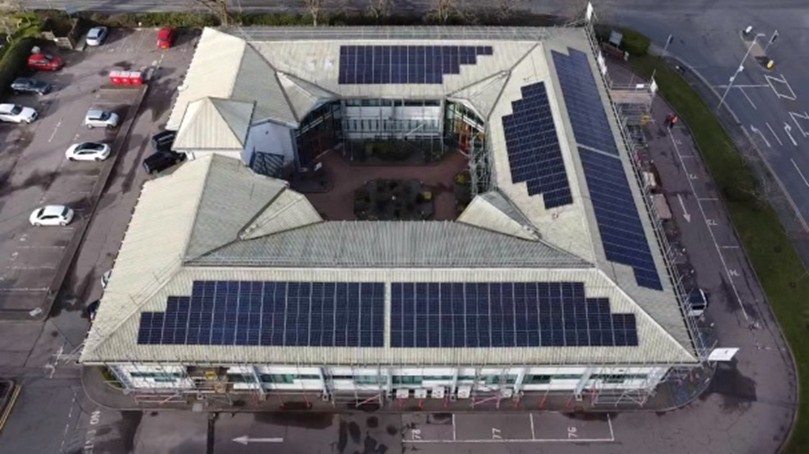
Over 18 tons of CO2 currently saved per year by Hapgood Solar installations
The Hapgood Workspace business model of refurbishing and repurposing existing commercial buildings offers significant carbon reduction advantages over new construction by preserving existing structures and minimizing the need for energy-intensive materials. The production of steel, concrete, and glass components of new builds emit large quantities of carbon dioxide. By refurbishing, these materials remain in use, reducing the demand for new resource extraction and manufacturing.
Refurbishment retains much of a buildings embodied carbon, preventing the release of additional emissions linked to demolition and reconstruction. Furthermore, renovation often requires fewer materials, further lowering the projects environmental impact.
The paper “Carbon footprint benchmarking data for buildings”, by the Institute of Structural Engineers indicates equivalent Carbon emissions (KtCO2e) for refurbishment at just less than 5% of new build. Refurbishment projects consistently show a lower ratio of Carbon to both buildings area and cost, indicating that these are a way of helping us towards the “Net Zero” requirement
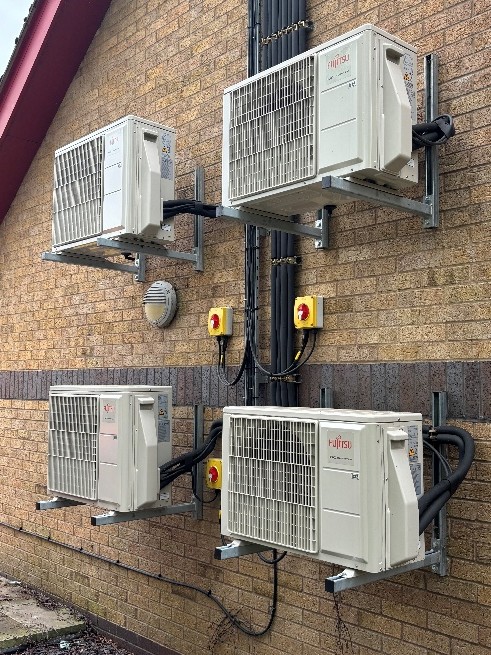
Operational carbon emissions are also reduced through refurbishment. Upgrading insulation, windows, heating, and cooling systems improves energy efficiency, cutting long-term emissions. Hapgoods office refurbishments generally include renewable energy sources, such as solar panels or heat pumps, further enhances sustainability. Having large commercial roof areas, and daylight electric usage has allowed Hapgood Workspace to install several Solar generation schemes. Current installations are saving over 18tons of CO2 pa, with further schemes planned for 2025 to bring this up to a saving of 34tons of CO2 pa.
By prioritizing refurbishment over new builds, Hapgoods model refurbishment provides significantly lower carbon emissions and contributes to a more sustainable built environment.